

The switch flipped, the smart electrical panel went live, and at least two things became true:
We saved ~$9000.00 by avoiding an expensive electrical service upgrade.
A talented young electrician gained experience with a technology he can now offer other clients in a situation similar to ours.
It was a win-win.
Let me back up.
To determine how much electricity a home needs, an electrician runs a “load calculation”. The result dictates the size of the electrical service required from the grid to the house, and is expressed in terms of number of “amps” (or amperage, A). For an average-sized single family residence built today, a 200 A service is usually sufficient, even for a fully electrified home. Some fully electrified homes can get by on a 100 A service with careful planning, especially in milder climates1.
We had upgraded the electrical service from 60 A (very old) to 200 A one year before we decided to change our plan from building a new house in the meadow to updating the House that Moses Chaplin built.
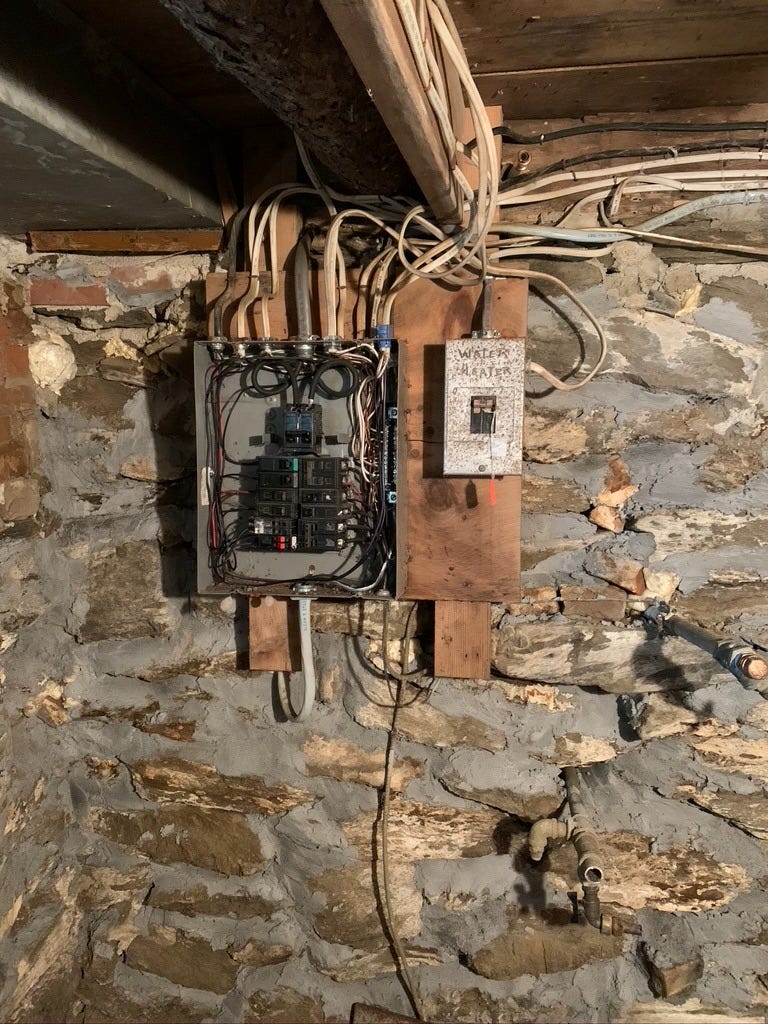
While the 200 A upgrade was done before we had planned to extensively renovate and fully electrify this house, I assumed it was going to be adequately sized for the new vision of the house. This was based on prior experience with another fully electrified home, and some cursory reading. I didn’t give it another thought as we embarked on the renovation work.
You can see where this is going….
We were well into the project when a new electrical firm (Richard Electric) joined the effort, with Colby as the head electrician. As part of his diligence, Colby ran a standard load calculation, per the code and based on the existing and planned electrical systems. The calculations were clear– we were looking at an upgrade to 400A.
We weren’t excited about that news, because a service upgrade is:
Expensive. A 400A service installation was expected to be about $12,000.
Almost certainly unnecessary, code nothwithstanding. We had fully electrified another home prior to this project, and had installed an energy monitoring system (Emporia Vue) that allowed us to see both total power consumption and use by each individual circuit. That house has a 200 A service, and it has never drawn more than 85 A.
A small-scale example of an important contributor to rising electricity costs for all of us:
A bigger electrical service often means the power company will install a larger transformer on the pole outside the house.
The power company must ensure sufficient power generation capacity to meet the higher loads implied by a bigger service, even if the house never actually demands that much power. Our house is less than a rounding error for grid scale capacity calculations, of course. But multiply that “capacity oversizing” by thousands of homes in a grid area, and the utilities could end up adding extra power generation and transmission capacity to the grid for demand that may never materialize.
The costs for (a) and (b) are most often shared by all rate payers. Grid upgrades of all kinds have been, and will be, costing rate payers plenty across the country. Rising electricity costs are a complex, multifactorial issue (increasing frequency and magnitude of repairs to the grid from storm damage, demand growth–driven largely by data centers, hostility towards bringing on new renewable energy generation by the current federal administration, incentive structures that encourage utility companies to install equipment with guarantee of a healthy profit, etc.). Finding a way to avoid an upgrade, especially with an approach that could be used by the many homes that will be fully electrifying as we transition from fossil fuels, seemed like a good idea.
So, what to do?
Before we talk about the solution we landed on, a little background on load calculations is required.
Standard load calculations are designed to ensure there is adequate electricity supply to the home even if nearly all of the electricity demanding devices and systems are on at once.
Imagine…it is a beautiful, moonlit winter evening in Vermont. Two EVs are charging in the garage (lovely to have our friends visiting for a snowshoeing/skiiing weekend). The heat pump is cranking away (clear skies, -14 ℉ without the wind). Two tired snowshoers are each taking showers, while the dishwasher is running and wet snow pants are in the dryer. Meanwhile, I am reheating leftover pizza in the microwave while baking chocolate chip cookies in the wall oven and boiling pasta on the induction stove (a carb loaded feast for the winter sports enthusiasts). Lights are on in every room.
This is a very unlikely scenario, of course. I would never microwave leftover pizza–soggy and leathery crust, yuck!
Having almost all the circuits in the house on at exactly the same time is also a fairly remote possibility. But with a standard electrical panel, there is no way to guarantee that the “all on” situation won’t occur. And because the “all on” scenario can happen, the assumption is that it will happen at some point. The code-specified load calculations ensure the electrical service is sized to meet this “all on” demand. The ultimate intent of the code is to prevent circuit overloads, equipment failure, and house fires, so this conservative approach is a good thing.
Enter the “smart” electrical panel
There is now a more flexible way to manage loads: a “smart” electrical panel.
One feature of a smart electrical panel is that it monitors how much power is being drawn by the home at a whole-home and circuit level. That allows a smart panel to detect when whole-home electrical demand gets close to the safe service limit, and dynamically manage the circuit loads in response. A smart panel can temporarily turn off one or more circuits (this is often referred to as “load shedding”) to prevent demand exceeding the safe limit. And when the demand from other circuits has reduced to the point that the systems that had been turned off can be accommodated, the smart panel turns them back on. This all happens in the background without the homeowner needing to do a thing, and almost always without the homeowner even noticing that this has occurred.
For example, in our above scenario, imagine the house with a 200A service. When the oven is turned on to bake the chocolate chip cookies while all the other systems are running (car chargers, dryer, hot water heater, etc.), the smart panel detects that adding the oven load on top of the other concurrent loads would exceed the safe limit. It responds by temporarily turning off the EV chargers2, which makes enough room for the oven to run and keep total demand under the safe limit for a 200 A service. And when the cookies are done and/or the clothes are dry and there is enough capacity freed up, the car chargers are turned back on automatically.
With a smart panel, we could have our smaller 200A service and our (chocolate chip) cookies too!
Importantly, code makes allowances for load shedding devices like the smart panel I just described, which effectively enable the electrician to ignore the circuits controlled by the smart panel when calculating load (since they can be dropped to zero as needed).
Moving forward
Colby and I had a discussion. While he hadn’t done a smart panel installation before, he was game to learn and explore! So I got to work to explore options.
Smart panels are now available from a number of different manufacturers. This 2026 review does a nice job laying out features that might help choose one over another for a given situation, though I am not sure it makes sense to “rank” them. Smart panels can have additional benefits beyond avoiding system “upsizing” in retrofits and new construction, including: (1) helping to maximize backup battery life during a power outage by dynamically managing which circuits are on and off throughout the outage, (2) reducing homeowner cost and grid-associated CO2 emissions by providing the option to time the use of certain “time insensitive” circuits (e.g.—car chargers, hot water tanks, some HVAC systems, etc.) so they run when electricity is least expensive (i.e.—off-peak hours) and/or when the power grid is supplied mainly by less polluting energy sources, (3) providing real time monitoring of power use and enabling remote circuit level control by the homeowner.
After some due diligence, we chose the Lumin Smart panel to meet our goals. Lumin’s technical sales lead, Phil Roth, was remarkably helpful in this process. He answered my many questions about how the system worked and how it could meet our objectives. Phil even came to commission the system, and was a great partner to Colby throughout.
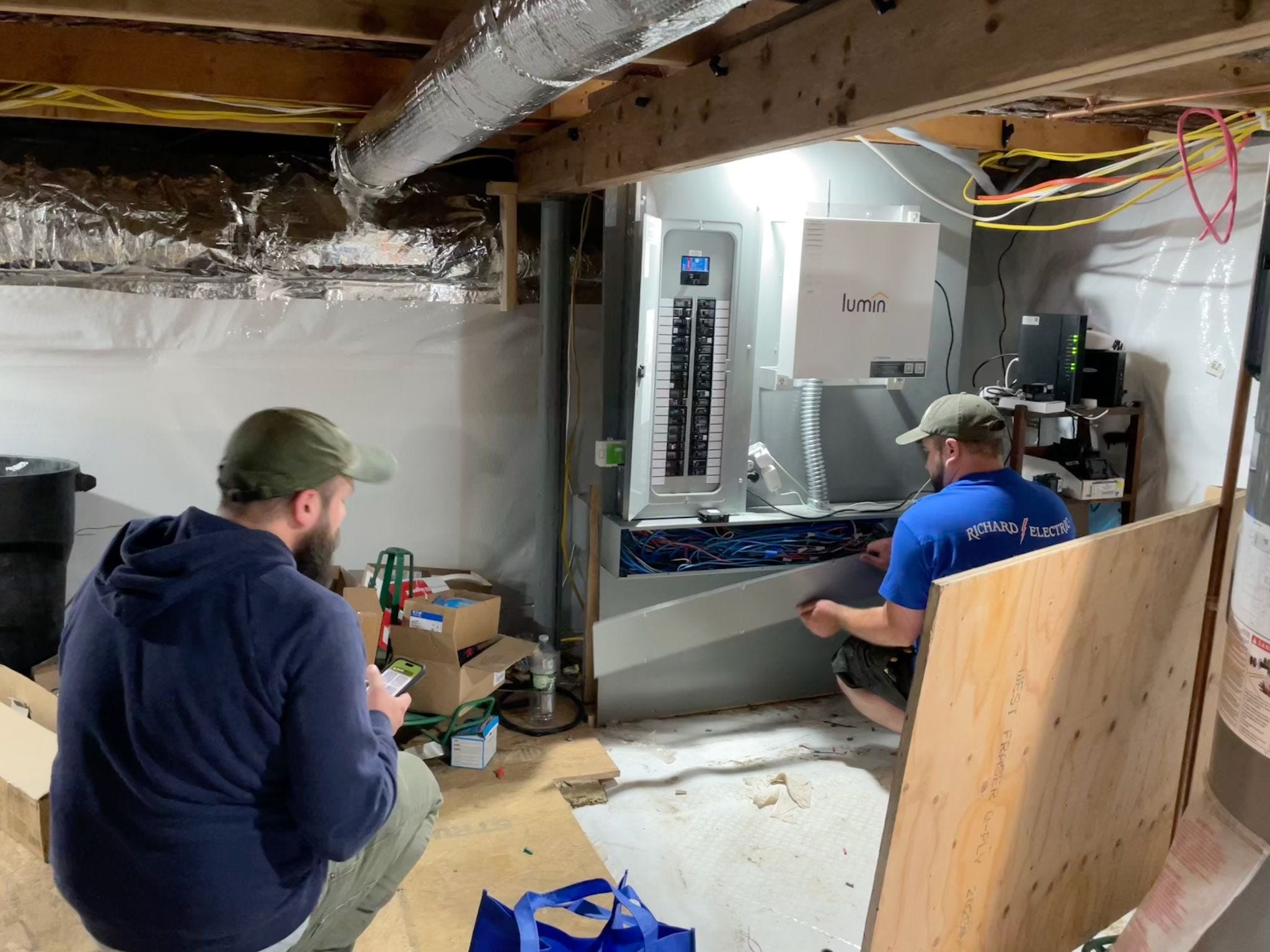
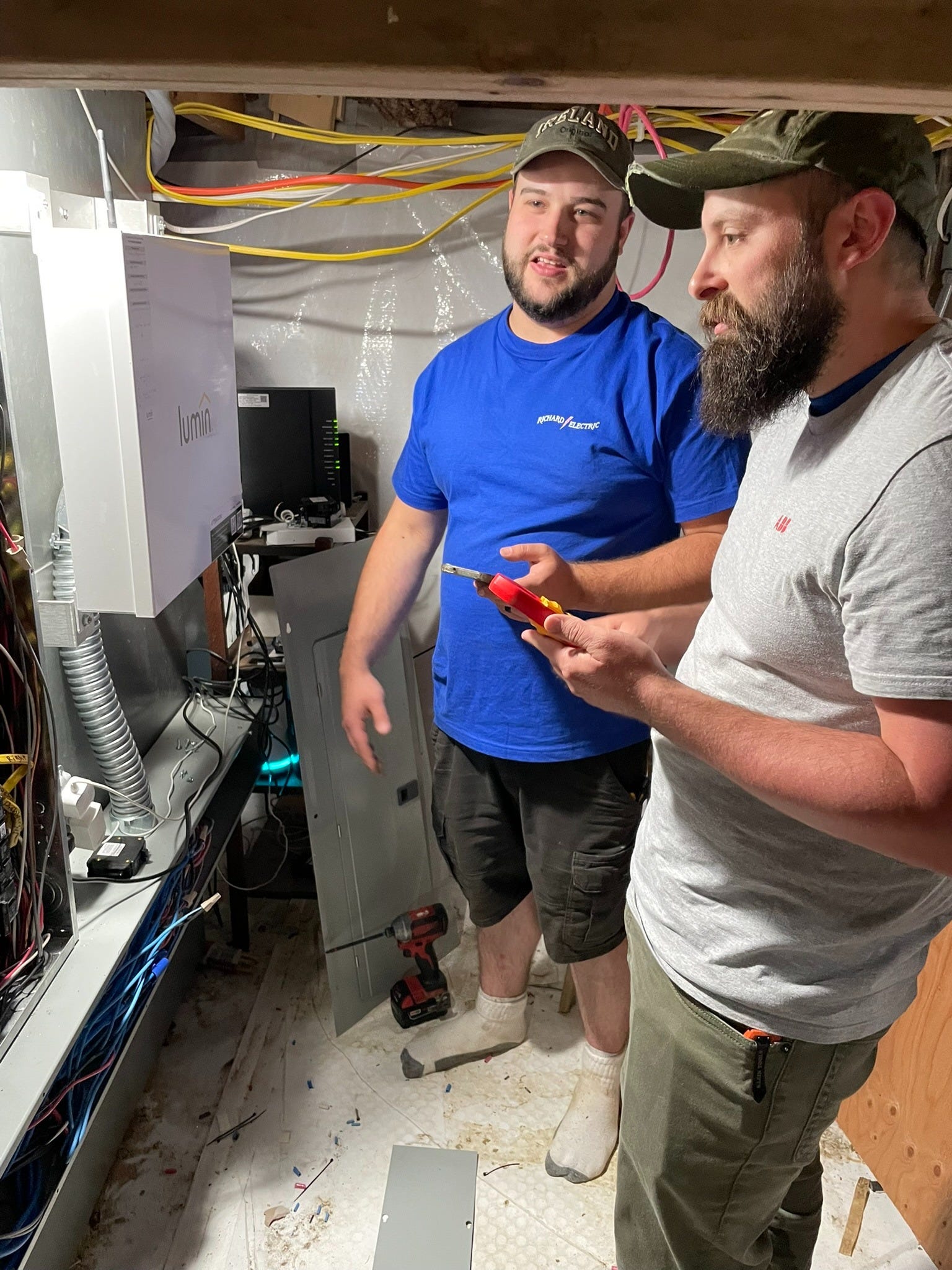
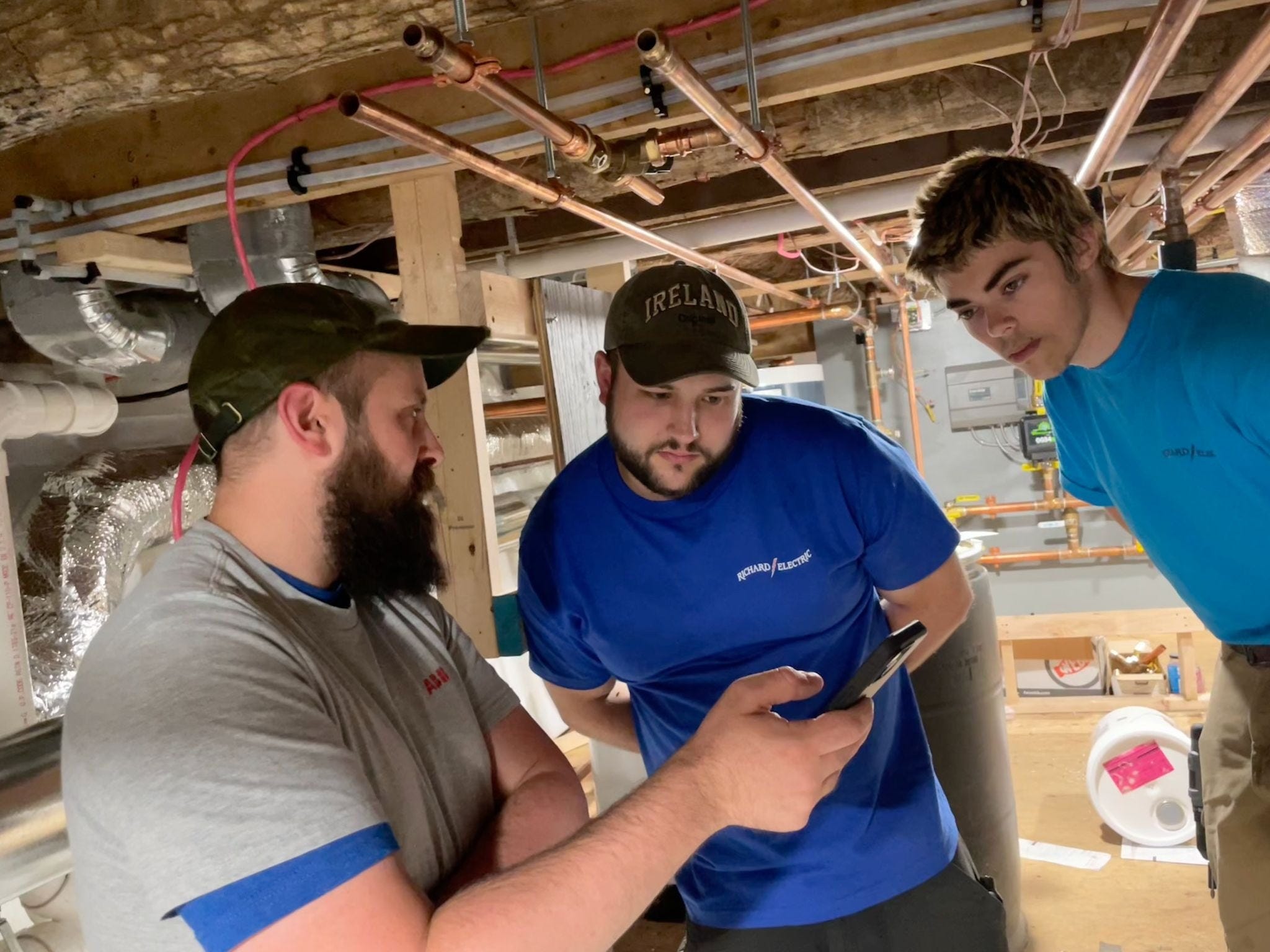
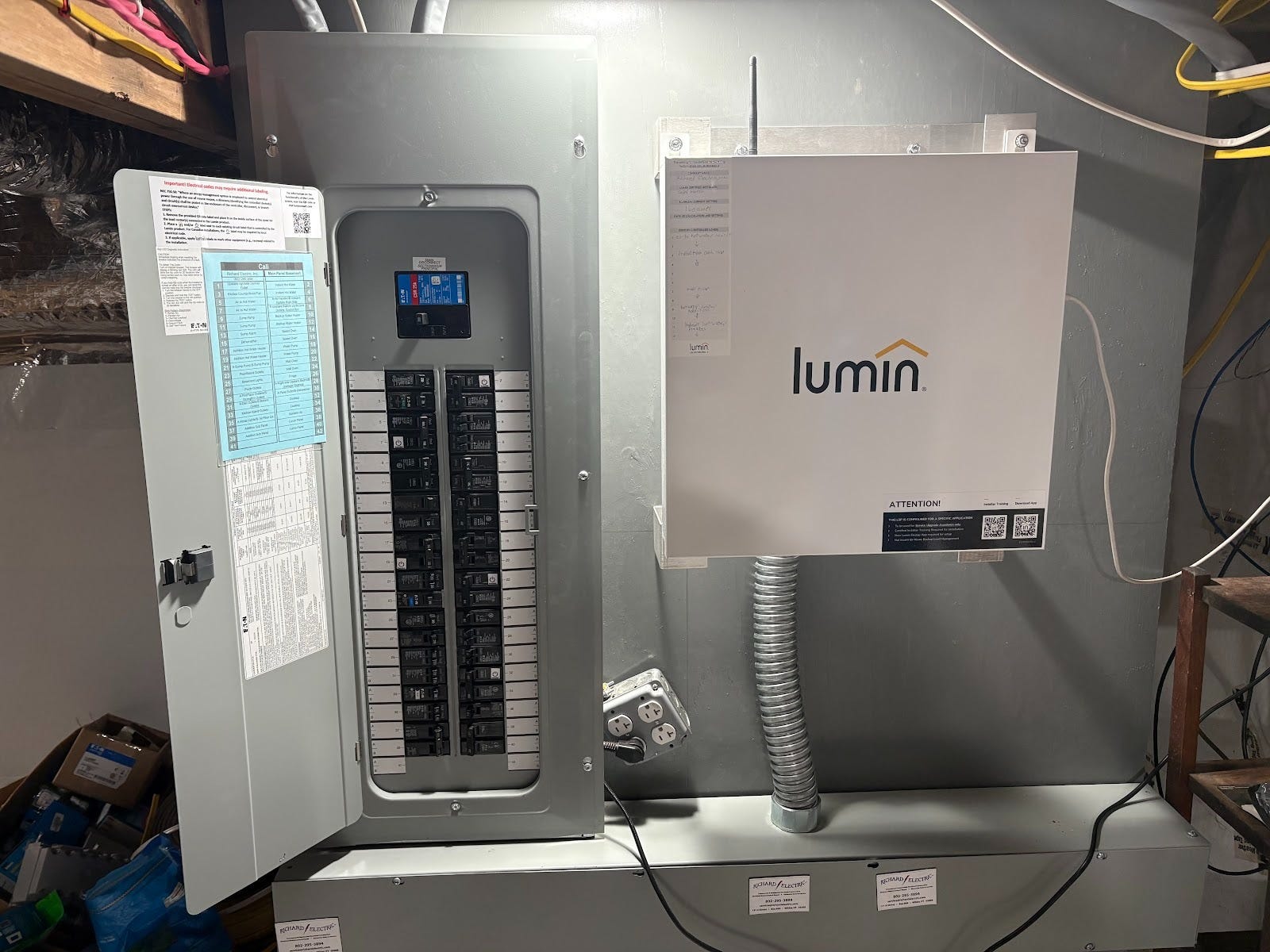
Colby took it upon himself to write up his experience with the Lumin system, which is in full at the end of this post. He offers insights that are especially useful to both the technically-minded homeowner and fellow electricians who may be interested in this technology. If you are a homeowner who is less technically inclined but intrigued by the benefits that a smart panel can bring, you may want to share Colby’s post with your electrician. And of course, if you live in the Upper Valley and have interest in a smart panel, consider giving Richard Electric a call!
So…does it work?
I admit to looking at the Lumin app almost daily to collect information on the power consumption of my various systems. It was especially helpful as I was trying to understand the power use and efficiency of our air-to-water heat pump system (more on HVAC in another post). The data are clear and reliable–overall monthly power usage numbers reported by Lumin match almost perfectly well with consumption reported on our monthly power bills.
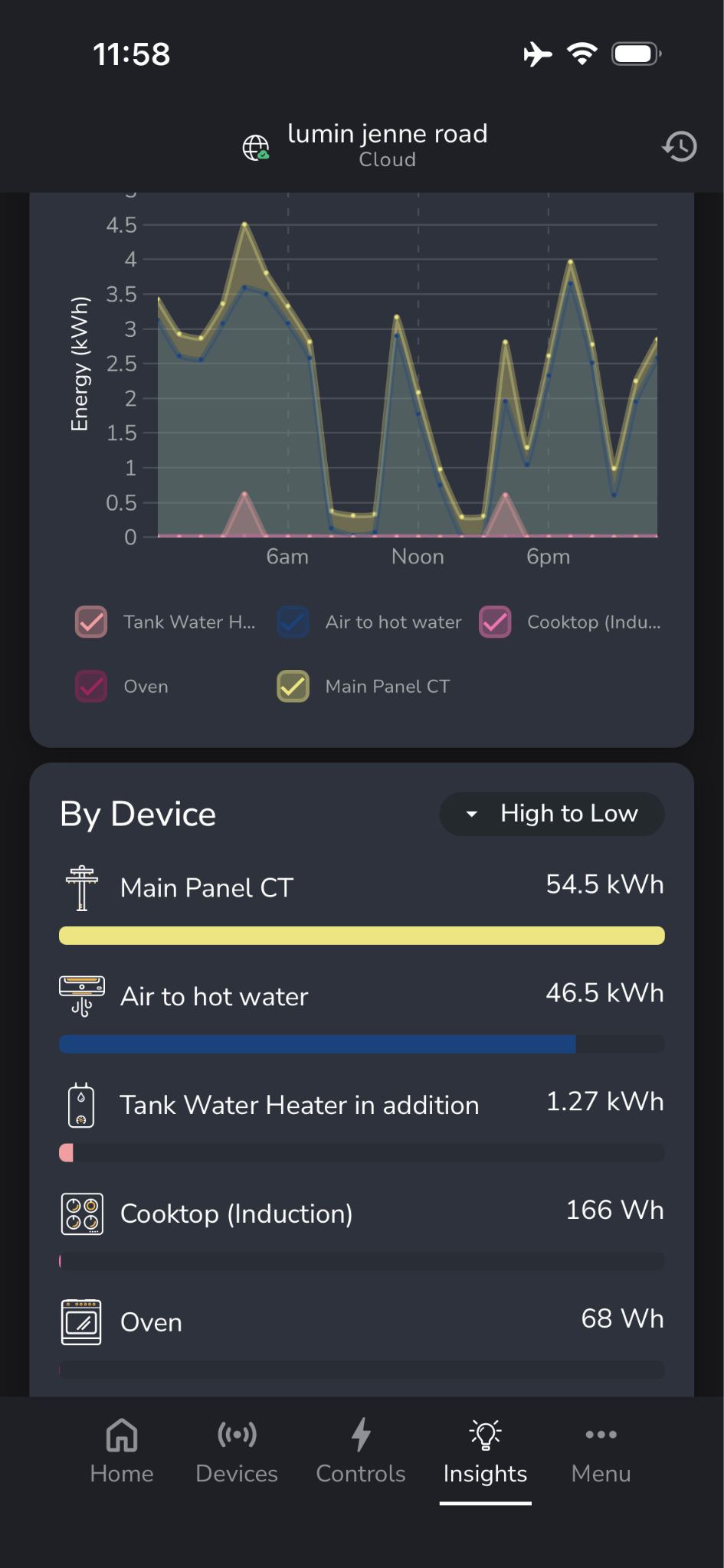
As for how the Lumin panel managed load shedding…a little context.
We are just over 8 months into our Lumin smart panel experience, including the passage of a very cold and snowy winter, as I write this. Throughout this past fall and winter, the air-to-water heat pump kept us perfectly warm even when it got down to -15 ℉ without the wind chill (more on HVAC in a different post). Our car charger kept the EVs charged up. Chocolate chip cookies were made in the wall oven. Many meals were made on the induction stove, and plenty of food (NEVER pizza) was reheated in the microwave. Friends and family came to snowshoe and ski, and they showered, and dried clothes. We hosted a 20 person youth group retreat, a 10 person climate retreat, and a 22-person Thanksgiving weekend extravaganza.
And how many times did the Lumin panel have to shed a load to stay under the 160 A “safe limit” for our 200A service during all that use?
Zero.
We never even got close.
A deeper dive
Smart panels can be a good choice for some homes in both retrofits and new construction. And they are just one small part of a much larger trend to make our homes and the power grid “smarter” overall, which present very real opportunities for increased cost savings and better reliability for all. While this is well beyond the scope of this post, if you are interested in learning more about opportunities for grid-scale improvements, a recent episode of David Roberts’ Volts podcast provides a good starting point. Volts is full of many inspiring examples of what solutions are already here, and what is coming, to help accelerate and simplify the ongoing clean energy transition.
Colby’s Review of the Lumin Smart Panel install experience, in his own words:
Overall thoughts
Sleek, practical design, and easy to install
Very user-friendly, for both professionals and homeowners
Great surface mount installations
Potentially difficult recessed installations
Using a wire way or a junction box is a great way to cut down on excessive wiring in panels
The installation guide is comprehensive and easy to follow
Well-structured and intuitive online training course
App is well organized, easy to navigate, and honestly pretty cool
All Lumin employees (most interactions with Phil) have been incredibly responsive, informative, and helpful. Obvious passion for and (well-deserved) pride in their work. It’s been a pleasure working with everyone I’ve come into contact with.
Experience
I’m not gonna lie, this install was very intimidating before the work started. I pretty quickly had those anxieties invalidated, though, as my entire experience with the people, products, and teaching tools of Lumin was exceptional. I’m delighted and incredibly grateful for this experience and the opportunity to work with such extraordinary professionals (and homeowners). If it weren’t for people like Brian and Sophie, I would not be allowed to do something amazing like this. From the beginning, it seemed like a lot of weight on one’s shoulder performing a load calculation, knowing that in both the standard and non-standard method that we were looking at a 400 amp service, and then having Phil run the same calculation through his home brew spreadsheet, saying that we can definitely get this service under wraps…and I was awestruck. I’ve only had the opportunity to be involved in fewer than a dozen installs of services larger than 200 amp, and not one of them has been a cake walk, so to have someone confidently say that we would not have to go through another back-breaking install of a 400 amp service, I was beyond relieved. From the moment that I opened the box, I was impressed by the quality and overall organization of the panel. The mounting bracket and premade whip were amazingly easy to install. I do think that having an alternate location to make the points of connection is very beneficial to not overfilling the panel, and also allows for easy wire tracing if any issues arise. The overall installation was very smooth, but I do think that depends on how clean a panel you’re working with and how easy it is to access the pre-existing wiring and modify it. I will recommend that you make sure you check the length of all wires on the premade whip, especially that of the CT wiring that will have to reach the top of the panel to get the proper readings that the Lumin needs to accurately manage the loads. Out of the whole process, besides the physical installation, the longest part of the whole install was setting the device up on WIFI and setting up the app. Partly this was due to the installer’s error, not knowing that the Lumin needed a direct connection to the internet and could not be set up on a wireless access point. After this was resolved, the rest of the installation went smoothly. The overall experience was a tremendous eye-opener into the world of load management and the opportunities that may now arise to use this device to suppress the need for a 400-amp service when most homes on an average day never use more than 35 amps resting. While traditional load calculations are essential for protecting services from overload, the expanding field of load management offers significant opportunities for improvement. By utilizing load shedding to preserve existing services, we can avoid the substantial costs associated with service upgrades. I believe this approach is a clear benefit for both contractors and homeowners.
Recommended Parts for Installation
One box of large blue Ideal wire nuts
One box of (single size) red Ideal wire nuts
One, 2-pole 20-amp breaker sized to fit the panel (i.e. Siemens, Eaton, Cutler-Hammer, GE, Murrey, etc.)
Either one 6in×6in×24in or one 6in×6in×48in wireway
Two, 6in×6in square end caps for wireway
One terminal ground bar kit 21 space
One, 2/0 main lug for proper grounding
Two, fully dressed 2½in×4in rigid conduit nipples with both locknuts and bushings
The Wire Marker Booklet by Ideal
Approximately 6 lag bolts for mounting wireway
Breakdown of cost
Labor rate
$98/hr for a fully licensed electrician
Additional $48/hr with an apprentice
Total hrs broken down
8.5 hours total
2 hrs were at the higher rate for the mounting of the Lumin panel and the mounting of the wireway to the panel location. One person could have done this, but it did help to have a hand in making sure all things were plumb.
4 hrs for the physical install at the base rate, mapping out the wiring, and making the proper splices and connections to the existing circuits that will be controlled.
2.5 hours of setting up the unit to the Wi-Fi and configuring the app with the proper loads, ensuring everything was in proper functioning order.
Total labor cost: $969.00
Total material cost: $435.10
This is based on the recommended materials list above, which includes all items used in this installation and a material markup.
Total cost- $1,404.10
This does not include the price of the physical Lumin device.
Rewiring America has some great information on how to potentially achieve electrification on 100 A, and this article from Canary Media also has some very useful approaches and links.
Car chargers are often the top of the priority list for a smart panel to “shed” if needed. They are a large load when running, and delaying charging for a short period will have no meaningful impact on mileage gained. Hot water heaters with a tank (which buffers short periods of turnoff) and electric clothes dryers are also common choices after EV charger(s).